

Context Without Perspective Is Not UnderstandinC
Document Creation Information
The content of this blog was written
entirely by a human. AI was used only to review the grammar and improve
readability.
Where images are included, they were created using ChatGPT 5.5.
The following is an extract from Words of Radiance by Brandon Sanderson [1]:
"Pattern," she said, tapping
her pencil—one she'd gotten from the merchants, along with paper. "This
table has four legs. Would you not say that is a truth, independent of my
perspective?"
Pattern buzzed uncertainly. "What is a
leg? Only as it is defined by you. Without a perspective, there is no such
thing as a leg, or a table. There is only wood. You have told me the table
perceives itself in this way because people have considered it, long enough, as
being a table," Pattern said. "It becomes truth to the table because
of the truth the people create for it."
Interesting, Shallan thought, scribbling away in her notebook.
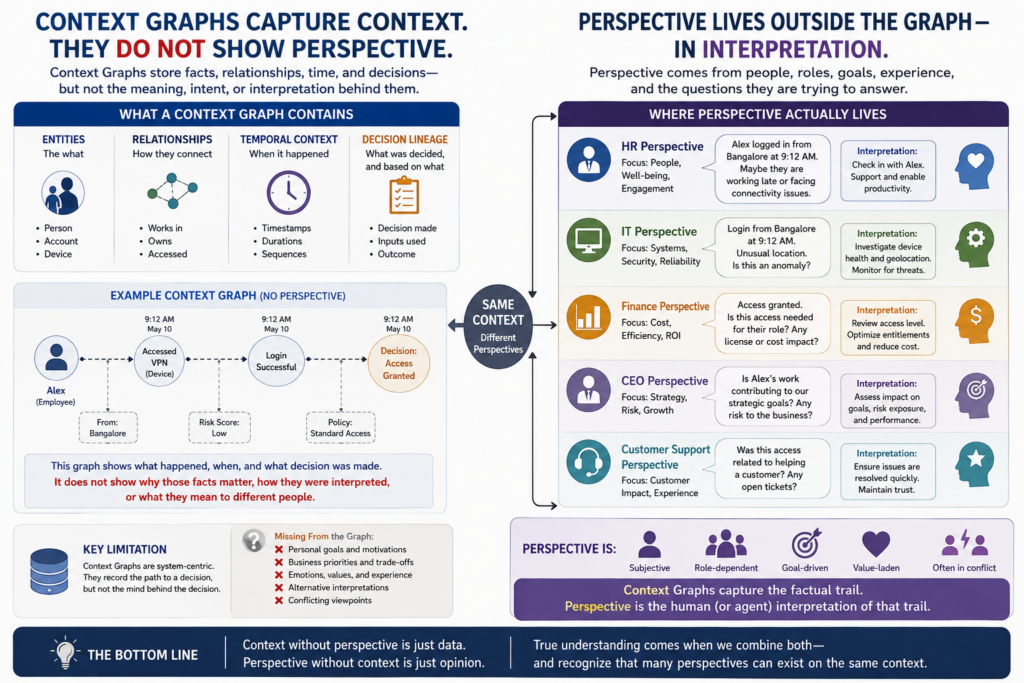
As AI continues to evolve, much of the recent discussion has centred around Context Graphs and their ability to preserve memory and meaning. As discussed in previous blogs, however, context alone is not sufficient; it must be accompanied by perspective to create meaning. Context Graphs may address the challenge of memory, but they still do not capture perspective.
A Knowledge Graph provides a
structured representation of entities and the relationships between them,
describing what exists within an organisation.
A Context Graph builds upon this
foundation by incorporating temporal context, events, and decision lineage to
explain what happened, when it happened, and why the system arrived at a
particular decision based on the information available at that specific
point in time.
A Context Graph does not capture perspective. Perspective is the interpretive lens through which individuals understand the same context. Different stakeholders—such as the CEO, HR, Finance, IT, or Customer Support—may examine the identical Context Graph yet reach different conclusions because each interprets the information according to their objectives, responsibilities, expertise, and business priorities.
In Sanderson's fantasy world, Pattern is a spren—a
manifestation of ideas, emotions, natural forces, or concepts. In this analogy,
Pattern represents an AI agent. Pattern does not recognise a "table"
or a "leg"; it sees only wood. It argues that Shallan perceives the
object as a table because that is her perspective. The object becomes a table
because people collectively assign that meaning to it.
This distinction highlights an important limitation of Context Graphs. While they can record what happened and why a decision was made, they do not capture the different ways in which that same context can be interpreted.
Some examples include:
- Alternative interpretations: Other valid
decisions or conclusions that could have been derived from the same
context but were not pursued.
- Conflicting stakeholder perspectives: Different
groups—for example, customers, Marketing, Legal, Product Development, or
Risk—may interpret the same customer information according to different
priorities and objectives. Although they share the same context, they may
arrive at very different conclusions about what constitutes a
"good" decision. A Context Graph that records only the final
decision lineage captures the chosen perspective but not the alternatives.
- Evolving subjective meaning: As Pattern
suggests, the "truth" of an entity can evolve through collective
human understanding. What people believe something represents today may
differ tomorrow. A Context Graph, anchored to a specific moment in time,
records the context surrounding a decision but struggles to represent how
the meaning of an entity evolves independently of any single decision.
Knowledge Graphs explain what exists.
Context Graphs explain what happened,
when it happened, and why.
Perspective explains why different people can interpret exactly the same context differently.
Without perspective, context records
history, but it does not capture understanding.
Reference
[1] Sanderson, B. (2014). Words of
Radiance. pp. 331–332.